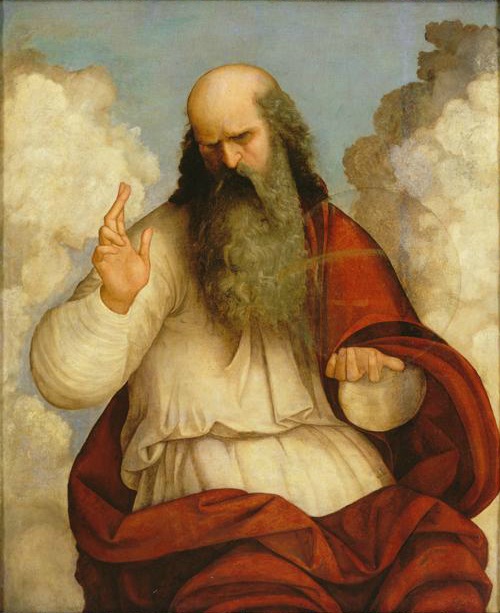
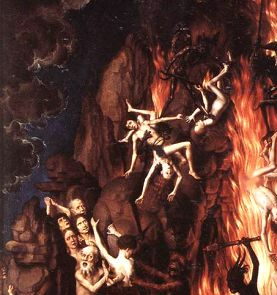
The main difference between Mormon heaven and Christian heaven is that in Christian heaven you get God because of Jesus' finished work; while in Mormon heaven you get god because of your works.
As we sat and discussed this reality with a young lady you could see that she was getting it. It wasn't a notion Evangelicals hold which was falling on deaf ears, no it was falling on listening ears, and from what it appeared they longed to hear more of this workless, grace-full gospel.
But time was cut short and it was time to leave.
So what happens to a missionary when they are so close to seeing one convert to Christ, but won't see it happen?
Trust.
The missionary must trust that God is sovereignly in control. The missionary must trust that God will bring his people to himself. The missionary must trust that, that one will be cared for by the Good Shepherd and brought to the fold of God. The missionary leans not on his own prowess in speaking eloquently but on God's Spirit to save completely.
The missionary must trust that it is for God to save and for man to proclaim.
"... Through the insincerity of liars whose consciences are seared..." 1 Tim 4:2
"If these words refer to 'demons' then this word will mean men deceiving through th instigation of th devil. But we may also supply the words, 'of men speaking.' He now descends to a particular instance, when he says that they 'speak lies in hypocrisy,' and have their consicences seard with a hot iron. And indeed, it ought to be known that these two are so closely joined together that the former springs from the latter; for consciences, that are bad and seared with the hot iron of their crimes, always flee to hypocrisy as a ready refuge; that is, they contrive hypocritical pretences, in order to dazzle th eyes of God; and what else is done by those who endeavor to appease God by the mask of outward observances."
"The word hypocrisy must therefore be explained agreeable to the passage in which it now occurs; for, first, it must relate to doctrine, and next it denotes that kind of doctrine which adulterates the spiritual worship of God by exchanging its genuine purity for bodily exercises; and thus it includes all methods contrived by men for appeasing God or obtaining his favor. The meaning may be thus summed up; first, that all who assume a pretended sanctimoniousness are lead by the instigation of the devil; because God is never worshipped aright by outward ceremonies; for true worshippers, 'worship in spirit and truth,' (John 4:24) and, secondly, that this is a useless medicine, by which hypocrites mitigate their pains, or rather a plaster by which bad consciences conceal their wounds, without any advantage, and to their utter destruction."
It seems fitting to read the following on the day the
Supreme Court makes, what is expected to be, and landmark decision concerning
religious liberty in America.
“But it matters enormously if I alienate anyone from the
truth.”
“Let me implore the reader to try to believe, if only for a
moment, that God, who made these deserving people, may really be right when he
thinks that their modest prosperity and happiness of their children are not
enough to make them blessed: that all this must fall from them in the end, and
that if they have not learned to know him they will be wretched.” And therefore
he troubles them, warning them in advance of an insufficiency that one day they
will have to discover.
“The life to themselves and their families stands between
them and the recognition of their need; he makes that life less sweet to them.
I call this Divine humility because it is a poor thing to strike our colors to
God when the ship is going down under us; a poor thing to come to him as a last
resort, to offer up ‘our own’ when it is no longer worth keeping. If God were
proud he would hardly have us on such terms: but he is not proud, he stoops to
conquer, he will have us even though we have shown that we prefer everything
else to him, and come to him because there is ‘nothing better’ now to be had.”
“The same humility is shown by all those divine appeals to
our fears which trouble high-minded readers of scripture. It is hardly
complimentary to God that we should choose him as alternative to Hell: yet even
this he accepts. The creature’s illusion of self-sufficiency must, for the
creatures sake, be shattered; and by trouble or fear of trouble on earth, by
crude fear of the eternal flames, God shatters it ‘unmindful of his glory’s
diminution.’ Those who would like the God of scripture to be more purely
ethical, do not know what they ask. If God were a Kantian, who would not have
us till we came to him from the purest and best motives, who could be saved?
And this illusion of self-sufficiency may be at its strongest in some very
honest, kindly, and temperate people, and on such people, therefore, misfortune
must fall.”
“…For about a hundred years we have so concentrated on one
of the virtues – ‘kindness’ or mercy – that most of us do not feel anything
expect kindness to be really good or anything but cruelty to be really bad.”[1]
When C.S. Lewis wrote these words in 1940, “Kindness,” ruled
the day, but now over 70 years later, “Love,” rules. Starting somewhere - in
the 1960’s I’d assume – love became the new pet virtue.
What we’ve seen is that our definition and understanding of
love, that is what we’ve been conditioned to recognize as love, is nothing more
than the obtaining of sex. And, therefore, the denial of sex is pure
hatred.We’ve been had. We have
been lied to.
The lie is that sex is the true meaning of love. Whether
this happened by some terrible accident of marketing, “Sex sells,” or it was
some grand scheme of the devil (who needs no congratulations if it was) I don’t
know. But what I do know is that the conditioning we’ve been conditioned to
know as reality is truly a fiction.
A reconditioning not just of our knowledge but also of our
feelings is what is required. We can know all we want about the facts of what
Christian (and by that I mean true) love is, but that ought to influence our
hearts – our emotions. Our conditioned understanding of love as sex must be
reoriented to the true meaning of love, God.
But still more we must understand all virtues in this
manner. This is the heart side of the matter of belief. In faith our emotions are
impacted in a biblical way. So things that are truly unjust are seen and felt
as such; things that are kind are seen as kind; and love is seen as Love.
Yet we live in – as Lewis called them – pockets and in these
pockets we have convinced ourselves of our own goodness, our virtuousness. But
as we look from our 21st Century pocket to the pocket of the Middle
Ages we call them cruel and mean while they would see themselves as courageous
and chivalrous and us as cowardly and apathetic.
Indeed we ought to really be a horror to God and ourselves.
Our pet virtue of love is really no virtue at all just a selfish desire of
sexual satisfaction and our understanding of our own time’s, “goodness,” is
simply because no one has yet interfered with us to the point of physical
violence with them (while mental violence has already accosted them).
We must relearn what it is to be truly human and that by the
blood of the cross.
What does it mean that God is
Father? Aside from the obvious answer that it means God is our Father, there
are many characteristics of God that are encapsulated in the description of God
as “father.” The providing aspect of God, his Kingship and, well you know, that
whole “Him” thing. Books like "The Shack" like to present God as the all-mother
or some such nonsense and dispense with the clearly written words of the Bible
for some gender inclusive (or just as exclusive as calling him father, but
that’s neither here nor there) shtick. But we, as Christians, call God Father.
The aspects of God, his love,
greatness, goodness, gentleness, awesomeness, graciousness etc. are not
qualities that we would necessarily look at and think that God’s a dude, rather
we’d think these cool qualities. But when coupled with his providence,
Kingship, leadership and general fatherly-ness we would need to assume upon his
fatherly nature because, well, he is our Father. As the Provider we his
children are given an old picture of a man bringing home what is needed to
give health, home and happiness to his family. As King we see a God fierce in
battle and mighty to save from the onslaught of demonic hosts and our own sin.
As Leader we see a God who is willing to do what is necessary to take his
people where he wants them go.
But something interesting occurs
when you strip God of his fatherly-ness. He becomes it and it becomes impersonal
and impersonal becomes impartial and impartial becomes careless and careless
becomes graceless and graceless becomes meaningless - meaningless to the point
of irreverence and disregard. So much so that culture uses his name as a byword
and a curse.
Culture has steadily and slowly
attempted at removing God’s personal qualities, namely that he is father. And
we are now, yes, even now, seeing the outcomes of those slow and steady
cultural modifications to cultural Christian understandings. The modern day
fight of the lesbian, gay, bisexual, transgendered (LGBT) movement for cultural standing
and inclusion is part and portion of the degenderization of the society at
large which is an outcome of removing God’s fatherly-ness from his personality.
It is also, I believe, part of the reason we see such drastic issues with out
of wedlock pregnancies and fatherless children, as well as the astounding 56 million
abortions that have legally happened since Roe V Wade.
Removing God’s Fatherly nature from
the written word, from our modern understanding of God and our cultural
understand of Christianity has done nothing in the way of help for our economy,
our children or our future. It is safe to argue that homosexuality is not an
economically sound decision because economics is based on buying units, of which,
homosexuals do not produce because they cannot reproduce. The same can be said
for abortion; on an economic point 56 million buying units have been lost thus
far, those are both dollars not being used but also jobs not being created or sustained
by one, if not all, of those 56 million. And statistically speaking a child
born out of wedlock is more likely to live life on welfare than one born in a
married family and is , therefore, a burden on the economy because a non-producing unit is
only consuming.
But father God is and father he
remains. He is father because he has revealed himself as such. He has spoken
clearly of who he is in his word, therefore we see him not as impersonal,
impartial and unimportant; no we see him as personal, partial and vastly
important and this changes everything.
We can't fight for the last word, just what's right.
If our King suffered, so shall we. We will suffer while watching children die on the altar selfishness. We'll suffer while watching friends run into folly. We'll suffer while the world around us runs from the one Person that can save it. Our God was aquatinted with grief, so too shall we be.
My professor, Dr. Greenham, spoke well against reincarnation. He said, “We are made to go on.”
Lewis says something similar. Something of how time is an odd thing and that because we view time as odd that this points to our not being made for the temporal but the eternal. That our terms of how, “Time has flown,” or how, “Time has slowed down to a crawl,” are hints at our eternality. We are not made for reflection or the entropy of reliving parts of life, no, we’re made to go on. Now and now and now, we’re made to go on and on and on, but never made to go back to how things once were. God himself will not return us to the Garden, he, rather, will create a city for our dwelling. Lewis does well to say, “Further up and further in.” For indeed this is what we are created for.
Something of this is freeing. Nostalgia seems such a happy place until compared to reality, then we spiral into the hope of how things were, never thinking of how things are let alone how things will be. But if creation longs to be made new (Rom 8) then ought’n we too? Should we not long for the consummation of all things in the enveloping arms of Christ the King? Yet here Lewis’ voice plays in my ears once more, “News from a country you’ve never visited… echoes of a tune you’ve not heard… the scent of a flower I’ve never smelled.” Indeed our longing for completion is evident in our nostalgia, but we cannot go backward to gain it, we must go on.
I’m finding more and more that I truly only know two things, that I am a great sinner and Jesus is a greater Savior (as Newton would say it). My feelings betray me. My heart is deceitful. My mind is a labyrinth of these's and those's, this’s and that’s. Even reality holds little to know, because I’m certain that just behind it’s frail curtain a war rages - a war of cherubim and seraphim fighting devils and demons - of light defeating darkness for the Dawn has come. There is comfort in seeing my ignorance.
Andrew Peterson has a song that has been capturing me, “Carry the Fire.” He sings, “We dream at night of city descending with the Son in the middle and a peace unending… Where joy writes the song and the innocent sing them…” The more I learn, the more those same two things are all I know. In some form or fashion all things are tied to the sinfulness of my soul and Christ’s redemption.
What’s my point in writing all these posts about money?
My point is this: We don’t need as much of it as we think we
do and we need to stop looking at what the perceivably rich people have and
gorging ourselves over their apparent wealth and our apparent poverty. There’s
a word for all this you know, “Coveting.”
Let’s just rebrand this whole “Inequality of Wealth” deal in
America to either a) “We’re Babies and Want the Other Kid’s Legos” or b)
“Selfish Coveters Who Are OK with Demanding to Have Your Stuff.” Take your
pick. Folks the grass is always greener somewhere else (sound familiar? Like
your mom said it when you were an incapable child?).
Take what you are given, what you earn (by the extravagant
grace, mercy and love of God who let you live, allowed you a job, and set you
in America) and use it wisely and shrewdly.
Remember that it is God who gives and takes away and that
those enormously wealthy people will have a hard time coming to the fountain of
grace because their money will hold them back. Remember that you too are one of
the 1% of the world by living in America and that to those to whom much is
given much will be expected. Remember to thank the Lord for his great provision
in your life and give to him your tithes and offerings. Remember God is King
and you; you are not. Remember that it’s free grace that saves our damnably
wretched souls and it is free mercy that rains down in our heart to make us
even notice God. Remember our biggest problem is our sinful rebellion against
God NOT the lack of some odd little trinket that will lose its entire luster in
a week.
There are some things we need, some things that are nice to
have, and everything else are just wants. Food and water those are necessary, we
need them to live. Shelter – a home – that’s nice to have, but not a necessity
necessarily. Then there’s all the stuff to go in the house, all of that is
socially dictated by the culture you’re in. Beds in India are floors sometimes.
Kitchens in Egypt are sparse. Showers in Uganda are rivers.
Food – God will give us our daily bread. Water – there are
people screaming out in hell for a drop on their ravaged tongues and it not
only drizzles on us here in America, but it floods from the skies at times. Are
you getting it? What you need has been provided in abundance here in America.
The “Inequality of Wealth” we’re talking about is the ability or inability to
get horribly made pieces of wood and ceramic at a store to stick on a wall and
smile at once! We’re whining at the fact that someone’s grass is greener than
ours! We’re discontented children screaming that their ice cream is bigger than
ours.
“Give us this day our daily bread and forgive us our trespasses
as we forgive those who trespass against us.”
A point here: Jesus didn’t instruct us to pray for
tomorrow’s food and sins, he told us to pray for today’s. The troubles of today
are enough in themselves, let tomorrow worry about its problems. If God gives
us food for the week he has taken care of today’s bread issues and given more
than we need. Anything you have beyond today is icing on the cake, cause only
the Lord knows whether or not you’re even going to live to use that icing.
(Also, a thought, God dictates what we need and don't need. He gives life and he takes life away. If what you need is to experience the fullness of God without shadow or veil - he gracously gives you death. So to say water and food are necessary, God defines what is neceassry and what is lifegiving.)
This “Standard of Living” stuff set out by our fancy
magazines and malls the size of cities and our selfish hearts are telling us to
buy the brand new X because that’s all we need to be happy. But then there’s Y
and Z to go along with X to make X look more fancy. But 1, 2, and 3 sit so
nicely beside X so they are necessary too, but don’t forget to buy the
insurance for X, Y, Z and 1, 2, and 3 else they brake and can’t be replaced and
hey, what do you know! Your paycheck’s gone.
Then we whip out that nifty slice of plastic and swipe it
away. Debt. And that just keeps crawling up there at the speed of a supersonic rocket.
Then we look at the people who live in fancy houses and think, “If only I could
live there, I bet they’re happy in that house.” Just to realize they have the
same problem we all have, namely selfish hearts and a society that tells us to
make ourselves happy with more stuff.
My point is that the rich aren’t the problem, sure they may
contribute to the problem, but they aren’t the problem itself. The problem with
the inequality of wealth in America is our selfish little hearts buying up stuff
we don’t even need and sometimes don’t even really want…
These kids have stuff made of trash and their doing just
fine. And Aldis is always selling cheap food and Goodwill has shirts for $3.49 and
you can buy boots that’ll last you a lifetime for 7 bucks, but someone else
wore them once.
My goodness people we can’t help but fall on our faces and
worship some new something with all our money. Then when we go to church and
when they ask for tithe we feel offended and affronted that some guy, let alone
some God, would ask for our hard earned cash – but no worries I’ll burn that
cash up on cigarettes (or some fancy meal) after service rather than see it
used by God for God’s purposes.
Have you ever felt like God was tangibly around you? Like if
you were to reach out and grasp the air something invisible would be there to
grip your hand back? Or what about knowing for certain the purpose for your
being was to do a certain thing? Like if the calling or essence or epitome of
your life was to _________. Have you ever felt either of those feelings, rather
knowings?
I know these are big abstractions about the Christian life;
one’s calling and feeling the closeness of God. I know many folks don’t “feel”
God move or even think to terribly much about him, and that when they do think
of him it’s a him who looks more like them than Him.
But truth has always moved through the ages. There have
always been those who take up the banner of divine revelation and say with
their blood, sweat and very lives,“Let good and kindred
go, this mortal life also, the body they may kill, but God’s truth abides
still!” That death
meant life and life meant Christ; that hope shattered chains and set prisoners
free; that grace burned through hatred and love prevailed in darkness.
There are those in this time, in this generation who stand
strong rooted in the Scriptures that God’s truth still lives, breathes and will
fell the deviations of the devil. Yes, they will loose their friends and their
family. Yes, they will walk away from all to follow the call. Yes, they will
feel the tangible nature of the Almighty and the hold of the Comforter and the
embrace of nail scared hands. Yes, they will walk as sheep among wolves. Yes,
they will shut the mouths of lions and put foreign armies to flight and be sawn
in two and live destitute of whom the world is not worthy. And yes, yes, it
will be worth it all.
It will be worth it all to hear the saints and angels sing, “Holy,
holy, holy is the LORD God almighty who was and is and is to come.” It will be
worth it to hear the proclamation over all eternity, “Well done my good and
faithful servant.”
Yet, we must stand firm and be watchful and believe with all
of every breath of God-gifted life the gospel of Jesus, that he has become our
sin and we have become, by divine decree, his prefect righteousness. Indeed we
are the recipients of grace upon grace upon grace.
But beware for, “Not everyone who says to me, ‘Lord, Lord,’ will enter
the kingdom of heaven, but the one who does the will of my Father who is in
heaven. On that day many will say to me, ‘Lord, Lord, did we not prophesy in
your name, and cast out demons in your name, and do many mighty works in your
name?’ And then will I declare to them, ‘I never knew you; depart from me, you
workers of lawlessness.’” (Matt 7:21-23)
Be sure of your belief. Be more than sure of the gospel. And be absolutely
sure that Jesus is your God-give hope, that Jesus is your Surety.
I've never really explained why my blog is called "Aspiring Spurgeon," which, I guess, is a huge over sight in the realm of the blogger types. So I'd like to take a couple posts and explain the name. First, however, I want to give you a quote from one of his sermons, then later we can jump into why a blog has a certain name.
"... The more vile a man is, the more eagerly I invite him to believe in Jesus. A sense of sin is all we have to look for as ministers. We preach to sinners; & let us know that a man will take the title of sinner to himself, & we then say to him, 'Look to Christ and you shall be saved.' 'Look,' this is all he demands of you, & even this he gives you. If you look to yourself you are damned; you are a vile miscreant, filled with loathsomeness, corrupt and corrupting others. But look here - see that man hanging on the cross? Do you behold his agonized head dropping meekly down upon his breast? Do you see his hands pierced and rent, & his blest feet, supporting the weight of his own frame, rent well-nigh in two with the cruel nails? Sinner! Do you hear him shriek, 'Eloi, Eloi, lama sabbacthani?' Do you hear him cry, 'It is finished?' Do you mark his head hang down in death? See you that side pierced with the spear, & the body taken from the cross? O, come you here! Those hands were nailed for you; those feet gushed gore for you; that side was opened wide for you; and you want to know how you can find mercy, there it is, 'Look!' 'Look unto me!' Look no longer to Moses. Look no longer to Sinai. Come you here and look to Calvary, to Calvary's victim, and to Joseph's grave. And look yonder to the man who near the throne sits with his Father crowned with light and immortality. 'Look, sinner,' he says this morning to you, 'Look unto me and be saved.' It is in this way God teaches that there is none besides him; because he makes us look entirely to him, and utterly away from ourselves."
I bet you're beginning to see why this preacher from one hundred years ago has made an impact on me. It's exciting to get to tell you how God used this man in my life so long after his death.
It's been almost two months since I moved from Wichita to Raleigh and in that time I've noticed I do one thing (at least) quite terribly - prayer.
Sure it's one thing to write out your prayer or speak it out to God, that's easy, to fill time with words and void with thought, but it's another thing entirely to listen to God speak, to shut yourself up, to let the pen stop scratching the page and listen. It's a treat really, to listen to the God who made all, sustains all, and holds all things together, but it's also a discipline (admittedly one I'm not very good at). What's more is the way God provides and heals and helps: food, money and shelter have been given to us but the task of listening to this Giver is still terribly difficult.
So here's to shutting up. Here's to saying nothing at all and spending silent time with the Creator of the universe, the Sustainer of your soul. Here's to having Scripture be your prayer and your answer. Here's to the God who hears and answers and speaks with His children tenderly about his love for them in Jesus.
This is the post about hell in its entirety. I would highly encourage
you to read this straight through, it will take a couple minutes, and there are a
few extra paragraphs that were not included in the other posts. At the end
is also a personal note, one that kept me studying and kept me writing while being tired of reading and thinking and writing about hell - it was hellish to allow
my mind to be consumed by thoughts of this terrible reality.
I pray this post will be helpful to all who read it. That in considering
hell it will spur you on to love, both of God and of man. To not spurn the
gospel of grace offered freely to us who justly deserve eternal hell - to both
believe with all our heart, strength, and mind the reality of God's love for us
in the gospel. That indeed Jesus has made peace between God and us rebels by
the blood of his cross.
Therefore read with an eye on the cross for your own sake and an eye on
your friends and family and remember Jesus' words on his way to the cross and
know he bore this in your place for your sins, "My Father, if it be
possible, let this cup pass from me; nevertheless, not as I will, but as
you will.” Matt. 26:39
Last week I wrote a couple posts
about an interesting topic that I apparently jumped fully into, that is the
topic of annihilationism. This is the idea that hell will end for those
condemned there after a time – that rather than suffering for eternity those
damned will be annihilated, that they’ll cease to be.
It seems there are four parts to
the annihilationist’s argument (of the more than one hundred comments on my
facebook post you’d think there are at least four hundred arguments for it and
just as many against it), these are:
1) The biblical references for the
‘destruction’ of the wicked,
2) The inconsistency of an eternal
hell with the love of God,
3) The injustice or unfairness of
the disparity between sins committed in this life and the punishment of eternal
torment, and
4) That allowing evil to continue
in hell would mess with the perfection of the universe God will create after
the Judgment Day. (Order taken from Wayne Grudem)
Over the next series of posts I
hope to respond to this doctrine, not only to respond to it but also to make
clear both the biblical stance as well as my stance on this topic of the
eternality of hell.
However
before we begin to look more deeply at this topic I want to make one thing
absolutely crystal clear and this one thing should be at the front of our minds
whenever we are discussing or thinking about the topic of hell, namely that we
are thinking about the outcome for millions of real people.
Hell
is real, whether one believes in annihilationism or eternal hell, it’s still
real and will still be awful and real people will go there. Friends, family,
moms, dads, brothers, sisters, children will inhabit this terrible place where
God justly pours out his wrath on those who are not saved by the blood of
Jesus. This MUST be at the forefront of our minds as we think about this topic.
The wrath of God is real, and it will be – and is - unimaginable.
Let’s begin our talk of hell with the wrath of God. It is
appropriate to think about this at the beginning because it is precisely what
we are dealing with when we are talking about hell – for it is the wrath of God
that comprises hell and therefore it is primarily the wrath of God that we are
dealing with when we reflect on hell.
The wrath of God is one of the perfections of God, in other
words it’s one of his attributes, one of his characteristics. We should study
it because it gives us a fuller picture of who God is (if we didn’t it would be
like getting to know your friends without letting them talk about themselves).
“The wrath of God is a perfection of the Divine Character on
which we need to meditate frequently, “ for three reasons, “First, that our
hearts may be impressed by God’s detestation of sin… Second, to beget a true
fear in our souls for God (Heb 12:28-29)… Third, to draw our souls in frequent
praise to Jesus Christ for having delivered us from, ‘the wrath to come,’ (I
Thess 1:10)(A.W. Pink).”
It would seem that the wrath of God is a rather unfashionable
thing to talk about; it’s not often that folks preach sermons about how amazing
and terrible is the God we worship and use texts about the utter destruction
and torment of the wicked in hell as their preaching passage. However we must talk
about the terribleness of which hell is comprised. And quite frankly I think Jonathan
Edwards expounding on I Thess. 2:16 are much better words than mine here (don’t
be intimidated that it’s Edwards I modernized it),
“How dreadful the wrath of God is, when it is executed to
the uttermost. To make you in some measure sensible of that. I desire you to
consider whose wrath it is. The wrath of a king is a roaring lion; but this is
the wrath of Jehovah, the LORD God Omnipotent. Let us consider what we can
rationally think of it? How dreadful must the wrath of such a Being be when it
comes upon a person to the uttermost, without any pity, or moderation, or
merciful circumstances! What must be the uttermost of his wrath who made heaven
and earth by the word of his power; who spoke and it was done, who commanded
and it stood fast! What must his wrath be, who commanded the sun and it doesn’t
rise, and seals up the stars! What must his wrath be who shakes the earth out
of its place and causes the pillars of heaven to tremble! What must his wrath
be who rebukes the sea and makes it dry? Who removes mountains out of their
place and overturns them in his anger! What must his wrath be whose majesty is
so awful that no man could live in the sight of it! What must the wrath of such
a Being be when it comes to the uttermost, when he makes his majesty appear and
shine bright in the misery of wicked men! And what is a worm of the dust before
the fury and under the weight of this wrath, which the stoutest devils cannot
bear but utterly sink and are crushed under it. Consider how dreadful the wrath
of God is sometimes in this world only in a little view or taste of it.
Sometimes when God only enlightens consciences to have some sense of his wrath
it causes the stout-hearted to cry out; nature us ready to sink under it when
indeed it is but a little glimpse of divine wrath that is seen…. But if a
slight taste and comprehension of wrath be so dreadful and intolerable what
must it be when it comes upon a person to the uttermost! When a few drops or a
little sprinkling of his wrath is so dreadful and overbearing to the soul, how
must it be when God opens the flood-gates and lets the mighty deluge of his
wrath come pouring down upon men’s guilty heads and brings all his wrath to
sink them! ‘When his wrath is kindled but a little, blessed are all they that
put their trust in him. (Ps. 2:12)’”
(It’s a long quote I know) We must be aware that the wrath
of God is terrible and a part of his divine perfections and as such we must not
think to small of our God to imagine that his wrath will not be or is not
utterly horrifying. While it may not be the cool thing to talk about it is
indeed part and portion of the God we worship and therefore must be considered.
But while considering it we cannot think that his wrath is mixed with the same
limitations or imperfections that we have in our ‘wrath.’ Surely we are justly
angry at times be we are also imperfect and ignoble in our anger – but God is
not.
In studying God’s wrath we will see exactly what we are
saved from through the propitiatory death of Jesus who stood, “Between us
sinners and the thunderclouds of divine wrath… (J.I. Packer).”
Passages to look up on the wrath of God:
Ex. 22:18-24; 32:10-12
Deut. 29:23-28; 11:16-27
Ezra 8:22
Ps. 2:5-9
Nahum 1:2-3, 6-8, 14
Amos 5:18-20
Matt 16:24-26
Mark 9:47
Lk. 12:47-48; 21:22-24
Rom. 1:18; 2:5; 3:5-8, 24-25; 12:19; 13:4-5
Acts 17:30-31
Eph 2:3
I Thess. 1:10; 2:16; 5:9
II Thess 1:7-10
Heb. 10:28-31
I John 2:2
Rev. 6:16; 16:19
Now let’s get the brunt of what these posts are about. We’ve
seen that the wrath of God no matter where one stands on the spectrum of hell,
that God’s wrath is indeed terrible and should cause us to fear Him. We’ve also
seen that God’s wrath isn’t mixed with imperfections like our, that it is a
perfect wrath.
So how does this wrath play out in hell? It’s real, hell. We
need to know that above all else hell is a real place and real people go there
(remember, keep that at the forefront of your mind).
Edwards makes a good case in the last post that if a little
of God’s wrath is intolerable what must it be to experience God’s wrath to the
uttermost? But what is the term on God’s wrath, is there a limit, does it end?
No, God’s wrath against sin does not end. Biblically God’s
wrath against sin does not end (This should be enough). Logically God’s wrath
against sin does not end. Temporally God’s wrath against sin does not end. In
terms of glory God’s wrath against sin does not end. In terms of perfection
God’s wrath does not end.
I want to present this in two ways, first in terms of a
rebuttal to the four main arguments for annihilationism (a necessarily negative
light) and second in terms of why one must believe that hell is unending (a
necessarily positive light).
In the first post I listed the main arguments of
annihilationism as this:
1) The biblical references for the
‘destruction’ of the wicked,
2) The inconsistency of an eternal
hell with the love of God,
3) The injustice or unfairness of
the disparity between sins committed in this life and the punishment of eternal
torment, and
4) That allowing evil to continue
in hell would mess with the perfection of the universe God will create after
the Judgment Day. (Order taken from Wayne Grudem)
In this post I hope to offer a rebuttal to these arguments.
Mind you this debate has been going on for years and I do not expect to change
their minds in this one post, in fact I fully expect more arguments will come
to show. (Some good resource to read are: Wayne Grudem’s Systematic Theology
page 1146 about Hell, J.I. Packer Knowing God chapter on The Wrath of God,
James Boice The Foundations of the Christian Faith chapter on The Wrath of God,
Jonathan Edwards sermons Sinners in the Hands of an Angry God, The Justice of
God in the Damnation of Sinners, Of Eternal Punishment and many others.) Many
of my arguments here are taken from Wayne Grudem’s Systematic Theology.
First the biblical references for the ‘destruction’ of the
wicked. References like Phil. 3:9; I Thess 5:3; II Thess 1:9; II Peter 3:7. “In
response it must be said that the passages of destruction do not necessarily
imply the cessation of existence.” (Hold on to your hats this part is a little
detailed and I’m no Greek scholar.)
In Phil. 3:9 and II Peter 3:7, “‘destruction’ is apoleia
which is the same as in Matt 26:8 to speak of ‘waste’ of the ointment. Now the
ointment did not cease to be, to exist; it was very evident on Jesus’ head. But
was ‘destroyed’ in the sense it no longer was able to be used on someone else
or sold.” This destruction is the type seen in these verses, not imply
annihilation but the simplicity of unable to be redeemed. Those who are in hell
are unredeemable; they did not believe the gospel of Jesus Christ and are bearing
the just eternal punishment of their sins.
In I Thess 5:3 and II Thess 1:9, “’destruction’ is olethros,
used also in I Cor 5:5 of delivering a man to Satan (putting him out of the
church) for destruction of the flesh – but his flesh did not certainly cease to
be when he was put out of the church…” So destruction is once again not seen as
ceasing to exist it is seen as being done away with in a permanent since.
Verses about the eternality of hell:
Matt 25:30-41, 46 see also Isa 66:4
Mark 9:43, 48
Luke 16:22-24, 28
Rev 14:9-11; 19:3; 20:10-15
I would highly recommend you look these verses up, especially the ones
in Revelation, which say things like “forever and ever.” All the verses are
linked for your viewing ease.
In the last post we looked at the first argument for the biblical
texts ‘supporting’ annihilationism. In this post we’ll look at the last three.
The second is that of the inconsistency that an eternal hell is to the
love of God. That For God to be truly loving then he would not damn any person
to an eternity in hell. However the same problem arises for the
annihilationists. In other words this is really a non-argument. It would be
unloving for God to damn anyone to hell forever, but it would be loving for God
to damn anyone to hell for a set time in such a way so as to annihilate them.
Do you see? On one hand it’s unloving to damn and on the other hand it’s loving
to damn is essentially the argument. (There is also another type of
annihilationism, called annihilationism proper or immediate annihilationism,
that is that upon death those unsaved completely cease to be and do not enter
hell at all. But this cannot properly be called punishment. Therefore it’s not
right because there would be no ultimate justice in the universe.)
Third is the inconsistency between the punishment and the grievance,
the sin committed. “The argument that eternal punishment is unfair wrongly
assumes that we know the extent of the evil done when sinners rebel against
God. (Grudem)”, “Sin against the Creator is heinous to a degree utterly beyond
our sin warped imaginations to conceive of….Who would have the temerity to
suggest to God what the punishment … should be. (Kingdon).”
Along this point it should be asked of the annihilationist if once a
person has entered hell and has served its ‘time’ is it then justified to be
annihilated? If the sin that was committed by this person is now dealt with in
their ‘time’ in hell, then why not let that person go to heaven? What is the
reason or point of annihilationism whatsoever if that person’s sins have been
dealt with fully in hell? (Grudem)
Fourth, that allowing evil to persist would be a corruption in God’s
perfect universe he creates after the Judgment Day. That hell exists in
eternity does not detract from the perfections of God’s universe, in fact it
enhances it. It forces us to realize that God has triumphed over sin perfectly
and, as Edwards said, to the uttermost revealing the glory of his justice and
the perfection of his wrath. That for all time his people will behold God’s
triumph over all evil.
On a side note before I end this particular post Grudem brought up an
interesting thing, one which I’ll post here as a warning – a shot across the
bow, if you will – of where, the dangers of fighting against the eternality of
hell could lead. “Because the doctrine of eternal conscious punishment is so
foreign to the thought patterns of our culture, and, on a deeper level, to our
instinctive and God-given sense of love and desire for redemption for ever
human being created in God’s image, this doctrine is emotionally one of the
most difficult doctrines for Christians to affirm today. It also tends to be
one of the first doctrines given up by those who are moving away from
commitment to the Bible as absolutely truthful in all that it affirms…”
We must believe that eternal punishment is true and just even though
it does hurt us to believe that there is a place that offers eternal
punishment. Even though the prospects of people going there is devastating.
This doctrine gives literal fire to our message of redemption.
Here I want to propose the arguments for the eternality of hell in a
positive light.
First it is biblical:
Matt 25:30-41, 46 see also Isa 66:4
Mark 9:43, 48
Luke 16:22-24, 28
Rev 14:9-11; 19:3; 20:10-15…
Second it’s reasonable:
If God is an eternal being and we have sinned against that eternal
being than it stands to reason that the just punishment for such a grievance is
an eternal punishment. We however are guilty of more than one sin, indeed we
are sinners are through and through. There is indeed justice for God in the eternal
damnation of sinners.
If God commands that we as his creation do not murder, that we do not
snuff out life in this reality, then how can God, who created the law, not be
subject to his own law and utterly destroy – annihilate, murder in completeness
of the word – people? It would seem that in so acting God must be unjust and
disobey his own decreed command and therefore not be perfect. In other words it
would mean that God is in fact not God and therefore not worthy of glory,
honor, praise, and eternal dominion.
If God’s wrath against sin terminates in the annihilation of a person
then what happened with Jesus? If Jesus bore the same wrath of God for sin for
Christians, as a non-Christian will bear to their annihilation then why was
Jesus not annihilated?
Third it’s traditional orthodoxy:
I’ll be the first to tell that just because something is traditional
that doesn’t mean it should be believed, you all know I’m a huge fan of the
reformation. But when it comes to orthodoxy these are areas, which must be
believed in order to have the gospel in its full potency. It is a good practice
to ask, “If this is doctrine is different or changed in any way does it change
the gospel? And if so how?” If the gospel is changed than the new doctrine or
changed doctrine should not be believed. Here, if hell is ending we loose much
of the potency of the powerful redemptive work of Jesus. Rather than saving us
from for all times from the wrath of God on sin, he only saves from the wrath
of God until the end of hell then after that… well that’s part of the question,
what does happen to those in heaven after hell is over? Is Jesus’ death still
effective? What happens to justification? What happens to redemption? What
happens to salvation after hell has ended? Are we still the redeemed and if so
what are we the redeemed from? Like the title of this post says, what the hell
am I saved from?
On this note is good to look at those who have believed this same
doctrine, has history vindicated their names against those who have been
proponents for other doctrines, names like St. Augustine, John Calvin, Martin
Luther, Charles Spurgeon, Peter and Paul. It is good to be in good company when
believing certain difficult doctrines. Here, if one were to believe that hell
has an end they would be in the company of Seventh Day Adventist or Jehovah’s
Witnesses, which are both commonly, referred to as cults.
In the last post I want to point out what believing in the eternality
of hell does for one’s Christian faith.
It seems odd to have a section that only highlights the benefits of
why one should believe in the eternality of hell. It’s crazy to think there are
pluses to this immense minus. But there are many.
First I would put this doctrine in my category of “Devastatingly Beautiful.” This is
where I put the doctrines that are so dangerous and devastating but also afford
and allow for such worship as cannot be brought by any song I’ve heard or sung.
The eternality of hell is devastating because real people go to a real
hell – forever. There are no second chances after death. In fact this life we
live has second chances every second. After death there is one place for those
who have spurned God’s call and shunned his righteousness and aimed to live
their own life without God. God mercifully gives them what they desire – an
eternity without his closeness. We cannot come to this dry-eyed or
bushy-tailed. This ought to take the wind out of our sails and crush us on the
rocks of devastation. People will die and they will suffer forever…
Think about that, people you know will die and they will suffer
endlessly. Think about their screams; try to imagine their pain. Now think
there’s away way out of that torment – that terrible suffering – a way has been
made to release you and them from your and their just damnation and his name is
Jesus! He bore that incomprehensible wrath in your place for your sins! Do you
love your friends? Of course, now tell them to be saved, redeemed by Jesus! At
the heart of the arguments on the limitations of hell is a dangerous plot to lose
the urgency of missions. Our dying world must be saved from the just torment of
eternity. And only God can save them from his own wrath through Jesus’ atoning
death.
Now think about the beauty of salvation! See the storm clouds of God’s
divinely just wrath poured out completely on Jesus – you see the only way that
Jesus could bear the eternal wrath of God is because he himself is a part of
the eternal Being. The only possible way for God’s entire eternal wrath to be
cleared from your name is if Jesus being fully God and full man stood and took
that wrath for you – it’s the doctrine of propitiation.
We cannot lull our friends or family into a false sense of security by
allow them to think hell is ending or that it is not going to be terrible. To
allow them to think such things would be like leading them there yourself.
Spurgeon said in Lectures to My Students something that has stuck with me for
years essentially it is this: Do not be a blind pastor leading you people
blindly to hell; an unredeemed pastor is like a blind man making claims about
beautiful paintings or a deaf man telling the world of Mozart, he cannot tell
the world of what he does not know. Therefore make sure you know and believe
the gospel lest you lead your congregation to hell and be greeted there by
their screams of torment, “You lead us here!” This will be the screams of those
we love if we do not tell them urgency and dangerousness of hell and the beauty
of the salvation of Jesus.
Ask yourselves what makes missions seem more urgent hell that is
ending or hell that is eternal? Ask yourself what makes God’s hatred against
sin more perfect hell that is ending or hell that is eternal? Ask yourself what
makes God’s salvation more inescapably beautiful hell that is ending or hell
that is eternal? Ask yourself what makes God’s glory so vast as to truly show
us that what we know of God is limited and finite hell that is ending or hell
that is eternal? Finally ask yourself what shows God’s way to be far higher
than our ways, hell that is ending or hell that is eternal?
As an end to this post, this post of hell, I want to add a personal note
(I really hope you watched the video). The glory of God is displayed clearly in
the death of Jesus - God in the flesh - that he stood in our place and bore an
eternity of punishment in his eternal Being. We are free because he has freed
us. Hell, this eternal suffering and torment that we should get for the rest of
forever has passed from us on to Jesus. Therefore the personal note that I want
to add here is simply this: BELIEVE!
Believe that God has and does love you personally! Believe that God does
love you unconditionally! Believe that God loves you irresistibly! Believe that
God loves us perseveringly! Believe that it is Jesus who has done all the work
you could never do and saved you from all that you deserve to bear – He literally
bore it in himself for you because of the deep, deep love of God!
If you do believe the gospel then believe it more and still and deeper!
After reading about hell it ought to stir your mind and pluck your heartstrings
to know that this damnable eternity is some people’s forever… Be broken! Be devastated,
but also turn to the cross of Jesus Christ and realize the full gorgeous beauty
of the gospel! That you are free from this proper damnation because of Jesus
and only Jesus!
“But now the
righteousness of God has been manifested apart from the Law, although the Law
and the Prophets bear witness to it – the righteousness of God through faith in
Jesus Christ for all who believe. For there is no distinction: for all have
sinned and fall short of the glory of God, and are justified by his grace as a
gift, through the redemption that is in Christ Jesus, whom God put forward as a
propitiation by his blood, to be received by faith. This was to show God’s
righteousness, because in his divine forbearance he had passed over former
sins. It was to show his righteousness at the present time, so that he might be
just and the justifier of the one who has faith in Jesus.” Romans 3:21-26
It seems odd to have a section that only highlights the benefits of
why one should believe in the eternality of hell. It’s crazy to think there are
pluses to this immense minus. But there are many.
First I would put this doctrine in my category of “Devastatingly Beautiful.” This is
where I put the doctrines that are so dangerous and devastating but also afford
and allow for such worship as cannot be brought by any song I’ve heard or sung.
The eternality of hell is devastating because real people go to a real
hell – forever. There are no second chances after death. In fact this life we
live has second chances every second. After death there is one place for those
who have spurned God’s call and shunned his righteousness and aimed to live
their own life without God. God mercifully gives them what they desire – an
eternity without his closeness. We cannot come to this dry-eyed or
bushy-tailed. This ought to take the wind out of our sails and crush us on the
rocks of devastation. People will die and they will suffer forever…
Think about that, people you know will die and they will suffer
endlessly. Think about their screams; try to imagine their pain. Now think
there’s a way out of that torment – that terrible suffering – a way has been
made to release you and them from your and their just damnation and his name is
Jesus! He bore that incomprehensible wrath in your place for your sins! Do you
love your friends? Of course, now tell them to be saved, redeemed by Jesus! At
the heart of the arguments on the limitations of hell is a dangerous plot to lose
the urgency of missions. Our dying world must be saved from the just torment of
eternity. And only God can save them from his own wrath through Jesus’ atoning
death.
Now think about the beauty of salvation! See the storm clouds of God’s
divinely just wrath poured out completely on Jesus – you see the only way that
Jesus could bear the eternal wrath of God is because he himself is a part of
the eternal Being. The only possible way for God’s entire eternal wrath to be
cleared from your name is if Jesus being fully God and full man stood and took
that wrath for you – it’s the doctrine of propitiation - because only an eternaly Being could bear an eternity of wrath in on the cross.
We cannot lull our friends or family into a false sense of security by
allow them to think hell is ending or that it is not going to be terrible. To
allow them to think such things would be like leading them there yourself.
Spurgeon said in Lectures to My Students something that has stuck with me for
years essentially it is this: Do not be a blind pastor leading you people
blindly to hell; an unredeemed pastor is like a blind man making claims about
beautiful paintings or a deaf man telling the world of Mozart, he cannot tell
the world of what he does not know. Therefore make sure you know and believe
the gospel lest you lead your congregation to hell and be greeted there by
their screams of torment, “You lead us here!” This will be the screams of those
we love if we do not tell them urgency and dangerousness of hell and the beauty
of the salvation of Jesus.
Ask yourselves what makes missions seem more urgent hell that is
ending or hell that is eternal? Ask yourself what makes God’s hatred against
sin more perfect hell that is ending or hell that is eternal? Ask yourself what
makes God’s salvation more inescapably beautiful hell that is ending or hell
that is eternal? Ask yourself what makes God’s glory so vast as to truly show
us that what we know of God is limited and finite hell that is ending or hell
that is eternal? Finally ask yourself what shows God’s way to be far higher
than our ways, hell that is ending or hell that is eternal?
Here I want to propose the arguments for the eternality of hell in a
positive light.
First it is biblical (this should be enough):
Matt 25:30-41, 46 see also Isa 66:4
Mark 9:43, 48
Luke 16:22-24, 28
Rev 14:9-11; 19:3; 20:10-15…
Second it’s reasonable:
If God is an eternal being and we have sinned against that Eternal Being than it stands to reason that the just punishment for such a grievance is
an eternal punishment. We however are guilty of more than one sin, indeed we
are sinners are through and through and those myriad of sins are all against the eternal God (Ps 51) and therefore are worthy of a myriad of eternal punishment. There is indeed justice for God in the eternal
damnation of sinners.
If God commands that we as his creation do not murder, that we do not
snuff out life in this reality, then how can God, who created the law, not be
subject to his own law and utterly destroy – annihilate, murder in completeness
of the word – people? It would seem that in so acting God must be unjust and
disobey his own decreed command and therefore not be perfect. In other words it
would mean that God is in fact not God and therefore not worthy of glory,
honor, praise, and eternal dominion.
Third it’s traditional orthodoxy:
I’ll be the first to tell you that just because something is traditional doesn’t mean it should be believed, you all know I’m a huge fan of the Reformation. But when it comes to orthodoxy these are areas, which must be
believed in order to have the gospel in its full potency. It is a good practice
to ask, “If this is doctrine is different or changed in any way does it change
the gospel? And if so how?” If the gospel is changed than the new doctrine or
changed doctrine should not be believed. Here, if hell is ending we loose much
of the potency of the powerful redemptive work of Jesus. Rather than saving us for all times from the wrath of God on sin, he only saves from the wrath
of God until the end of hell then after that… well that’s part of the question,
what does happen to those in heaven after hell is over? Is Jesus’ death still
effective? What happens to justification? What happens to redemption? What
happens to salvation after hell has ended? Are we still the redeemed and if so
what are we the redeemed from? Like the title of this post says, what the hell
am I saved from?
On this note it is good to look at those who have believed this same
doctrine, has history vindicated their names against those who have been
proponents for other doctrines, names like St. Augustine, John Calvin, Martin
Luther, Charles Spurgeon, Peter and Paul. It is good to be in good company when
believing certain difficult doctrines. Here, if one were to believe that hell
has an end they would be in the company of Seventh Day Adventist or Jehovah’s
Witnesses, which are both commonly, referred to as cults.
In the last post I want to point out what believing in the eternality
of hell does for one’s Christian faith.